
No products in the cart.
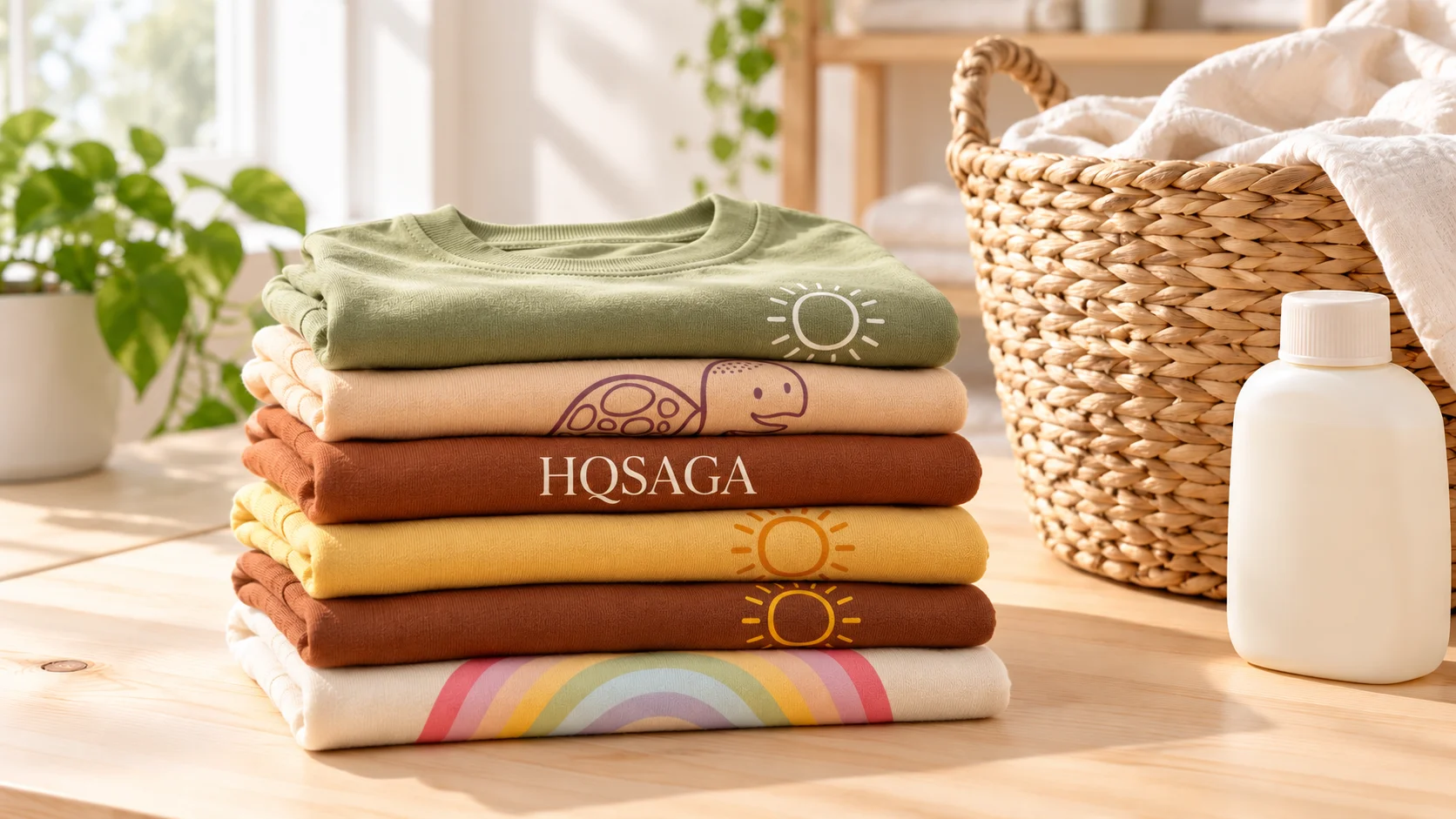
Toddler clothes get washed a lot. Yogurt, sidewalk chalk, whatever was in that puddle. So if you've invested in a tee for its fabric, it's fair to ask how to keep it in good shape through all of that. Here's the short answer, and then the reasoning behind it.
The HQSAGA™ Care Label, in One Place
Every HQSAGA™ tee carries the same care instructions:
| Wash | Machine wash cold with like colors |
|---|---|
| Detergent | Use mild detergent; avoid bleach |
| Dry | Tumble dry low or hang dry to preserve fabric and print |
| Iron | Do not iron directly on the graphic |
Our Our Fabrics page adds that avoiding bleach helps preserve color and fiber integrity. And per our FAQ, our garments have been evaluated for appearance after repeated washing with satisfactory results, and we recommend following the care label to help maintain fit and quality.
That's really the whole routine for how to wash organic cotton baby clothes from us: cold, mild, low heat, no bleach. (Curious about the fabric itself? See how we source our GOTS-certified organic cotton.)
Why the Care Label Is the One to Trust
Care labels aren't guesswork. Under the Federal Trade Commission's Care Labeling Rule, manufacturers must give complete instructions for regular care, and they need a reasonable basis (reliable evidence) for those instructions and warnings. The FTC also explains that "tumble dry low" means machine drying at a low temperature setting, and that labels must warn against procedures a consumer might reasonably use that would harm the garment. Learn more about laundry care symbols.
So general laundry tips, including the ones in this article, come second. If you ever see a difference between advice online and the label sewn into the shirt, go with the label.
Does Washing Reduce UPF?
This is the question we hear most. The honest answer is that it depends on the fabric, and research doesn't point in only one direction.
Washing doesn't automatically lower UPF. In a study published in the Journal of the American Academy of Dermatology, the UPF of an untreated cotton T-shirt fabric went up after five washes (by 51% with water alone and 17% with detergent alone), which the researchers attributed to fabric shrinkage. That study looked at ordinary T-shirt fabric, not our garments, so we don't treat it as a promise about any specific shirt.
Stretching and wetness do matter. The Skin Cancer Foundation notes that when clothing gets stretched or wet, it loses some of its protective ability, because stretched fibers pull apart and let more UV through. The CDC likewise says a wet T-shirt doesn't protect as well as a dry one.
Some UPF labeling methods account for wear. For example, ASTM D6544 prepares fabric with standardized laundering, simulated sunlight and chlorinated pool water to simulate two years of seasonal use before UV testing for labeling under ASTM D6603. Test methods vary by lab and standard, so ask the brand which method applies to its rating.
What we can say about our own tees: styles labeled UPF 50+ use fabric independently tested by TÜV SÜD, and following the care instructions helps preserve the garment's quality, appearance and performance. See What Is UPF 50+ for what the rating means.
Three Habits That Protect the Fabric
- Get the fit right. Since stretched fabric can let more UV through, a tee that's pulled tight across the chest isn't ideal. Our Size and Fit Guide has exact 1T–5T measurements.
- Swap out wet shirts when you can. After sprinkler time or a splash pad, a dry tee does more than a soaked one.
- Keep heat and bleach out of the routine. Both are specifically addressed on our label (cold wash, low or line dry, no bleach).
What About Fabric Softener on UPF Clothing?
Our care label doesn't call for fabric softener, and we weren't able to find authoritative, independent evidence on how softeners affect the UPF of organic cotton knits specifically. So we won't guess. If you'd like to use one, email us at hello@hqsaga.com and we'll give you a clear answer for your style.
Storing Tees Between Seasons
A few simple habits: wash everything before it goes into storage, make sure it's completely dry, and keep it somewhere cool and dark, like a closed drawer or bin. It also makes the next season's size check easier (more on that in the size guide).
When Is It Time to Retire a Tee?
Kids outgrow clothes long before most of them wear out. But if a shirt is still in rotation, these are reasonable signs to stop relying on it as a sun layer:
- Holes, or areas that look noticeably thin compared with the rest of the shirt
- Fabric that has been stretched out of shape
- Seams that are coming apart
About the "Hold It Up to the Light" Check
Holding a shirt up to a lamp or window can help you spot holes or thin patches, which is useful. But it can't tell you a garment's UPF, and it can't tell you whether a shirt still meets its rating. UPF can only be measured in a lab. So use the light check to find visible wear, not to judge UPF 50+ coverage.
Want to see how everyday UPF tees fit into a toddler's week? Read Everyday UPF Clothing for Kids, or browse the UPF 50+ collection.
Frequently Asked Questions
How do I wash HQSAGA™ tees?
Machine wash cold with like colors, use mild detergent, avoid bleach, tumble dry low or hang dry, and don't iron directly on the graphic.
Does washing reduce UPF?
Not automatically. One study found untreated cotton T-shirt fabric gained UPF after washing because of shrinkage, while stretching and wetness are known to reduce protection. Following the care label is the best way to preserve performance.
Will HQSAGA™ tees shrink?
Our garments have been evaluated for appearance after repeated washing with satisfactory results. Follow the care label to help maintain the best fit. More in our FAQ.
Can I test UPF at home?
No. A light check can show holes or thin fabric, but UPF has to be measured in a lab.
Can I use fabric softener?
It isn't part of our care label. Email hello@hqsaga.com and we'll advise for your specific style.
Leave a comment