No products in the cart.


Cotton is one of the most commonly used materials in everyday clothing. From T-shirts and baby clothes to dresses and bedding, it is a familiar choice for many households.
However, not all cotton is grown in the same way. When shopping for clothing, parents may come across two common terms: regular cotton and organic cotton.
So, what is the difference between organic cotton vs cotton, and does it matter when choosing clothes for children?
The main difference lies in how the cotton is cultivated and processed. Organic cotton is produced according to organic agricultural standards, while conventional cotton may be grown using synthetic pesticides and fertilisers. Understanding these differences can help parents make more informed decisions when buying cotton clothing.
Regular cotton, also known as conventional cotton, is cotton grown using conventional agricultural practices.
Depending on the region and farming method, conventional cotton cultivation may involve synthetic fertilisers, pesticides and herbicides. The specific inputs and processes vary between farms.
After harvesting, cotton fibres are processed into yarn and fabric. Additional steps, such as dyeing and finishing, may also be used before the material becomes a finished garment.
Regular cotton is widely used because it is versatile and can be manufactured in different weights, textures and fabric constructions.
Some common characteristics include:
It is important to remember that conventional cotton is not automatically low quality. The feel, durability and performance of a cotton garment depend on several factors beyond how the cotton was grown.
Organic cotton is grown according to organic agricultural standards. These standards restrict the use of certain synthetic pesticides and fertilisers and establish requirements for how the crop is cultivated.
Organic cotton production also focuses on approved agricultural practices and maintaining compliance with the relevant certification requirements.
Once harvested, the cotton is processed into yarn and fabric. Depending on the certification scheme, requirements may also apply to later stages of processing, manufacturing and handling.
Some important characteristics of organic cotton include:
Organic cotton is not a completely different type of fibre. It is cotton produced under a different set of agricultural and, where applicable, processing standards. You can see how this applies to our own clothing on our Our Fabrics page.
The most important distinction between organic and conventional cotton is the way the crop is grown and how its production is verified.
| Comparison | Organic Cotton | Regular Cotton |
|---|---|---|
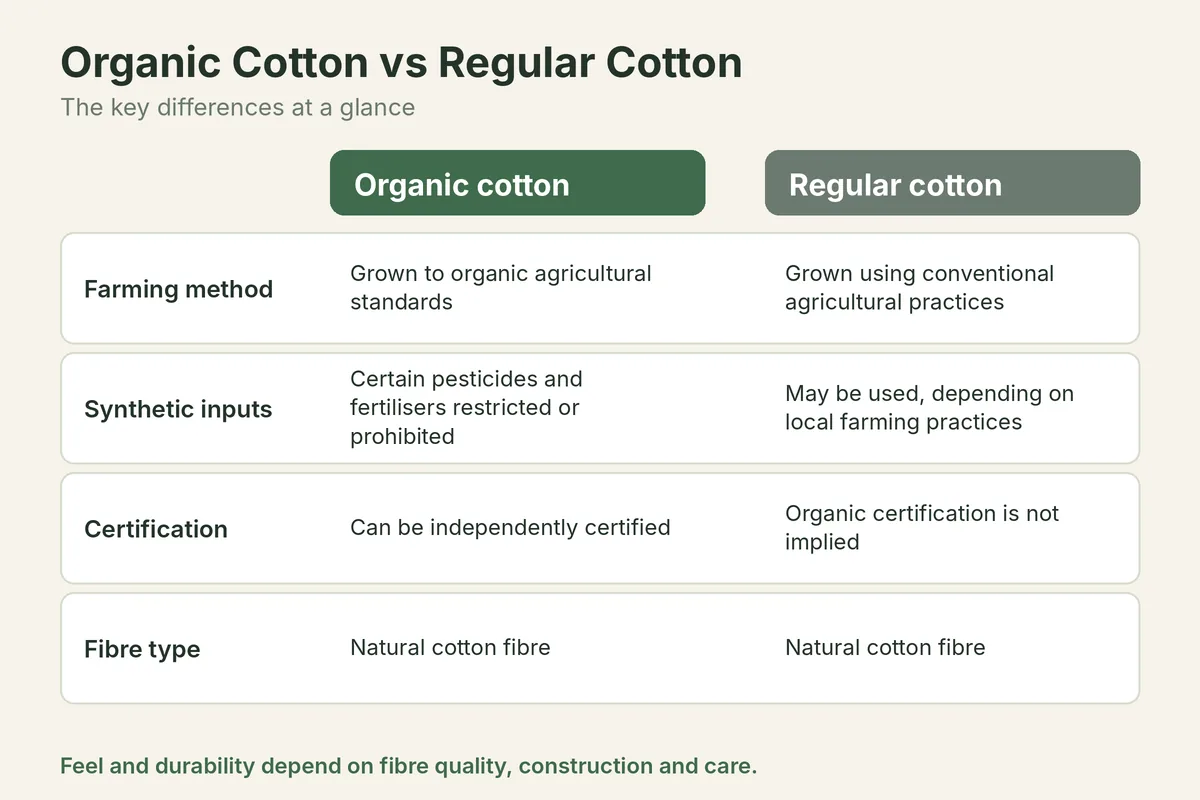
| Farming method | Grown according to organic agricultural standards | Grown using conventional agricultural practices |
| Synthetic agricultural inputs | Certain synthetic pesticides and fertilisers are restricted or prohibited under organic standards | May be used depending on local farming practices |
| Certification | Can be independently certified under recognised standards | May have other certifications, but organic certification is not implied |
| Processing requirements | Depend on the certification and its scope | Depend on the manufacturer and applicable standards |
| Fibre type | Natural cotton fibre | Natural cotton fibre |
| Feel | Depends on fibre quality and fabric construction | Depends on fibre quality and fabric construction |
| Durability | Depends on fibre quality, construction and care | Depends on fibre quality, construction and care |
| Appearance | Can be made into a wide range of fabrics and colours | Can be made into a wide range of fabrics and colours |
Both types of cotton can be used to produce comfortable, durable clothing. Organic certification primarily tells shoppers about production practices, not that every organic cotton garment will automatically feel softer or last longer.
The biggest difference between organic cotton and conventional cotton begins at the farm.
Conventional cotton farming may use synthetic pesticides, herbicides and fertilisers to manage crops and support production. The exact methods depend on local regulations, farming conditions and agricultural practices.
Organic cotton farming follows specific standards that restrict or prohibit certain synthetic inputs. Farmers must use permitted methods to manage soil fertility, pests and crop production.
These standards are intended to establish a different approach to agricultural production.
For shoppers, the distinction is useful because the term organic refers to how the cotton is grown, rather than simply describing the finished fabric.
Cotton farming is only one part of clothing production. After harvesting, the fibres may go through spinning, knitting or weaving, dyeing, finishing and garment manufacturing.
This is where certification becomes important.
Not every product labelled as organic cotton has necessarily been certified across every stage of its supply chain. Different certifications cover different requirements and stages of production.
For example, the Global Organic Textile Standard (GOTS) is a recognised textile processing standard for organic fibres. It includes environmental and social criteria across the textile supply chain, subject to its certification requirements.
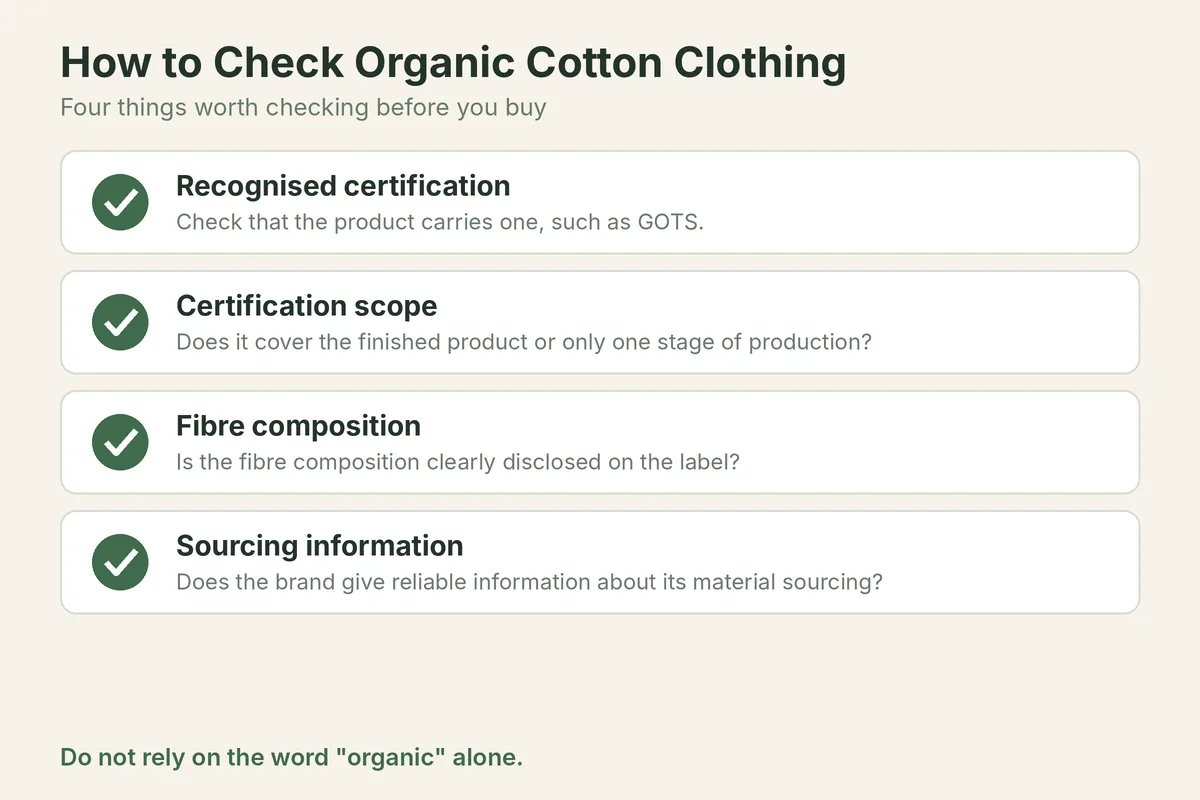
When purchasing organic cotton clothing, parents should check:
Certification provides more useful information than relying on an organic claim alone.
A common question among shoppers is whether organic cotton feels softer than conventional cotton.
The answer is not necessarily.
Both organic and conventional cotton can produce soft, comfortable fabrics. The final feel depends on several factors, including:
A well-made conventional cotton garment can feel softer than a poorly constructed organic cotton garment.
Therefore, parents should not assume that organic certification automatically means a garment is softer. It is better to consider the actual fabric quality and product information.

Organic cotton is not automatically more durable than conventional cotton.
Durability depends on the quality of the fibres, how the yarn is made, the fabric construction and how the garment is used and maintained.
For example, two cotton T-shirts may have very different lifespans even if they are made from the same type of cotton. Differences in stitching, fabric weight and garment construction can influence how well they hold up to repeated washing and everyday wear.
When comparing products, look beyond the organic label and consider the garment's overall construction.
Children's clothing needs to be practical for everyday activities. Whether choosing organic or conventional cotton, parents should evaluate the complete garment rather than focusing on one material claim.
Here are a few useful considerations.

Look at the product label or description to understand whether the garment is made from 100% cotton, a cotton blend or another material.
If a brand describes its clothing as certified organic, check the certification and understand what it covers.
The weight, knit, weave and finish influence how the clothing feels and performs.
Consider sleeve length, fit, stitching and whether the garment suits the child's everyday activities. Our size and fit guide can help you choose the right size.
Proper washing and drying help maintain the fabric's appearance and construction over time.
These checks help parents make informed decisions without assuming that one label guarantees every aspect of garment quality. For a wider checklist, see our guides on buying safe, comfortable children's clothing and what to look for when buying toddler clothes online.
Both organic and conventional cotton can be suitable for children's clothing. The right choice depends on your priorities.
| If your priority is... | What to consider |
|---|---|
| Understanding farming practices | Look for organic cotton produced under recognised standards |
| Verifying production claims | Check independent certification and its scope |
| Softness and comfort | Evaluate the actual fabric quality and construction |
| Durability | Consider stitching, fabric weight and garment care |
| Everyday practicality | Check the fit, design and washing instructions |
For parents exploring organic cotton children's clothing, it is useful to understand the material used in the products they purchase.

HQSAGA®®'s product range includes clothing made from 100% GOTS-certified organic cotton. The brand also offers garments with UPF 50+ fabric testing.
These attributes serve different purposes. GOTS certification relates to organic textile production requirements, while UPF testing relates to the fabric's ultraviolet protection performance.
Parents can explore HQSAGA®®'s collection of children's clothing to discover its available styles and product details, or read what makes HQSAGA®®'s approach to kids' clothing different.
The main difference is how the cotton is grown. Organic cotton follows organic agricultural standards that restrict certain synthetic pesticides and fertilisers. Regular cotton is produced using conventional agricultural practices, which may include these inputs.
Organic cotton may be preferable for consumers who prioritise organic farming practices and independently verified production standards. However, it is not automatically softer, stronger or more durable than conventional cotton. These qualities depend on fibre quality and fabric construction.
Not necessarily. Both organic and conventional cotton can produce soft fabrics. The softness of a garment depends on fibre quality, yarn construction, knitting or weaving methods and finishing processes.
Organic cotton is produced under standards that restrict certain agricultural inputs. However, organic certification alone does not guarantee that a finished garment is suitable for every baby's skin. Parents should also consider dyes, finishes, fabric construction and product information.
GOTS stands for Global Organic Textile Standard. It is a recognised standard that sets requirements for organic textile processing, including environmental and social criteria across the supply chain. The certification scope should be checked to understand which product and production stages are covered. Read how we source GOTS-certified organic cotton.
Organic cotton is not automatically more durable than regular cotton. The lifespan of a garment depends on fibre quality, fabric construction, stitching, washing practices and everyday use.
Both organic and conventional cotton are natural cotton fibres. Their breathability depends primarily on fabric weight, weave, knit and construction rather than whether the cotton was grown organically.
Check the product label, fibre composition and certification details. Look for recognised certifications such as GOTS and verify whether the certification applies to the finished garment or a specific stage of production. Do not rely solely on a brand describing a product as organic. For other questions, visit our FAQ.
The difference between organic cotton and regular cotton is mainly about agricultural production and the standards followed during cultivation and processing.
Both are natural cotton fibres, and both can be used to make comfortable, durable clothing. Organic cotton offers a way to identify cotton produced under defined organic standards, while conventional cotton is grown using conventional farming practices.
When buying children's clothing, consider more than the material label. Check fibre composition, certification, fabric construction, garment design and care instructions.
Understanding these differences makes it easier to choose clothing that matches your family's preferences and everyday needs.
Leave a comment